连通性问题——数据结构系列教程(c++版)
梦想不会自己发光,真正闪耀的是那个为梦狂奔的你。献给知行的孩子们!(Eric.He著)
图的连通性问题,指的是判断图中顶点之间是否能通过边相互到达。根据图的类型(无向图 / 有向图),连通性的定义和解决方法有所不同。针对无向图连通性问题,常用的算法包括深度优先搜索(DFS)、广度优先搜索(BFS),以及针对有向图强连通分量的 Kosaraju 算法、Tarjan 算法。本文将详细讲解无向图、有向图连通性的实现,内容由浅入深,所有代码可直接编译运行。
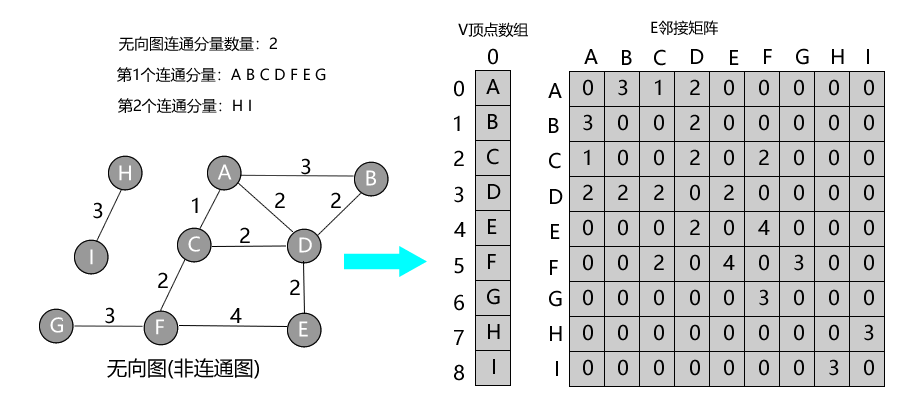
图结构的实现方式:
学习经典应用场景前,请根据上面的教程封装好自定义图,所有场景实例直接复用
一、基础概念
1.1 关键概念
首先要区分两类图的连通性定义:
- 无向图的连通性
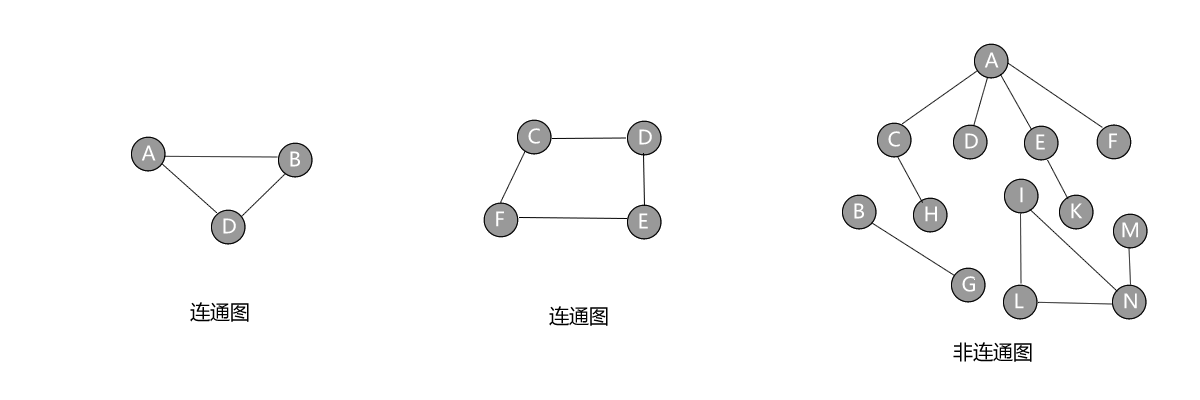
- 连通图/非连通图:无向图中,任意两个顶点之间都存在至少一条路径,整个图是一个 “整体”。假设图中随意两点能够相互到达,则称图为连通图,否则称图为非连通图。
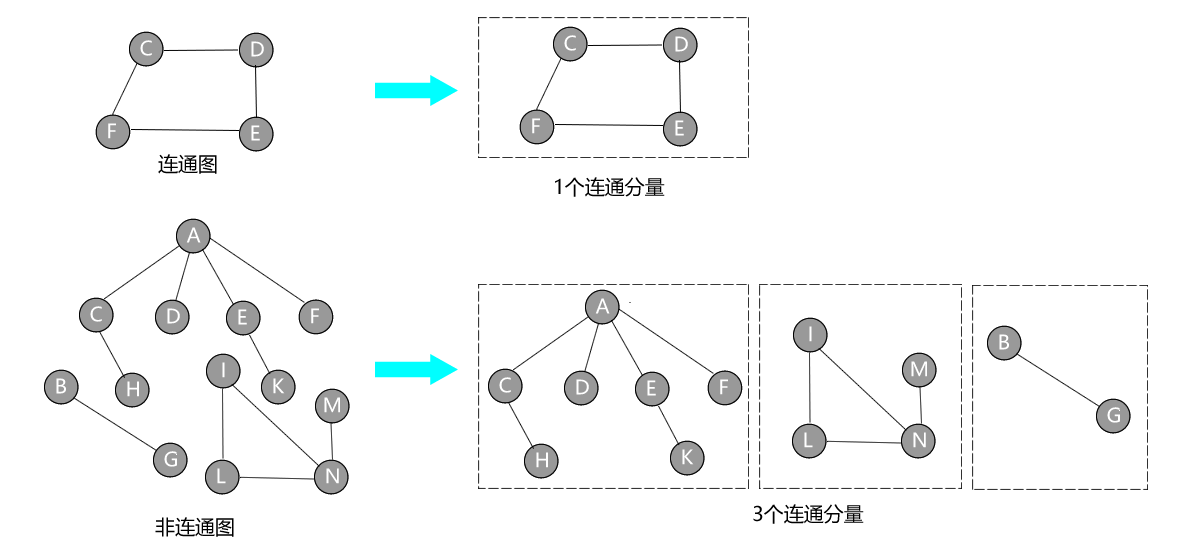
- 连通分量:连通图的连通分量只有 1 个(自身);若⽆向图是非连通图,但图中存在某个⼦图(最大的连通子图)符合连通图的性质,则称该⼦图为连通分量。比如一个无向图被拆成 3 个互不连通的部分,就有 3 个连通分量;
- 有向图的连通性
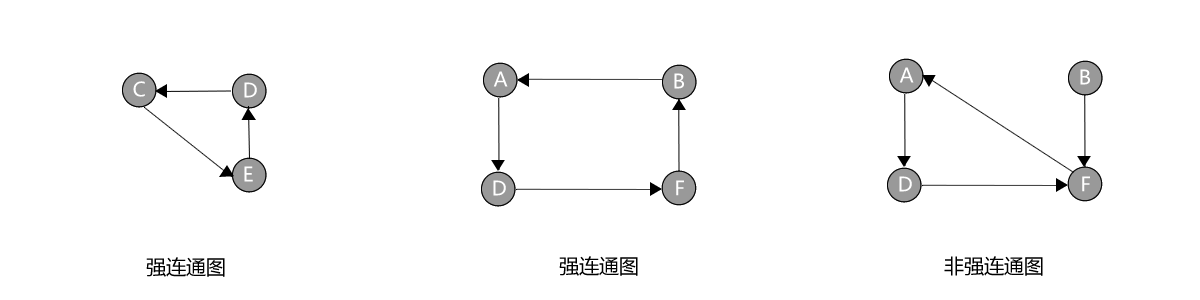
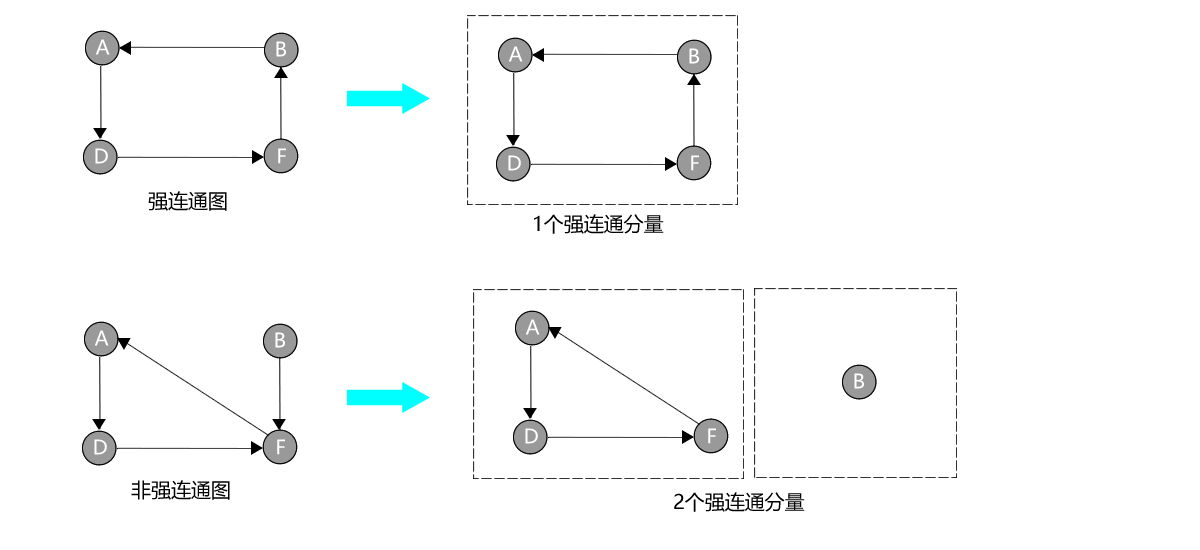
- 强连通图/非强连通图:有向图中,任意两个顶点 u 和 v,既存在 u→v 的路径,也存在 v→u 的路径,则称图为强连通图,否则称图为非强连通图。
- 强连通分量:若整个有向图 G 是强连通图(任意两点互相可达),则图 G 的强连通分量只有1个。若有向图非强连通,则其可以被划分为多个互不相交的强连通分量,这些分量覆盖图的所有顶点。
1.2 算法对比与选择
| 算法 | 时间复杂度 | 空间复杂度 | 适用场景 |
|---|---|---|---|
| DFS/BFS遍历 | O(V+E) | O(V) | 无向图连通分量统计 |
| Kosaraju 算法 | O(V+E) | O(V+E) | 有向图强连通分量(实现简单) |
| Tarjan 算法 | O(V+E) | O(V) | 有向图强连通分量(一次 DFS) |
一、无向图连通性---DFS/BFS遍历法
从任意顶点出发,通过 DFS 或 BFS 遍历所有可达顶点。若遍历后所有顶点都被访问,则图是连通的;否则统计连通分量数。
算法解析:
- 初始化一个 visited 数组,标记顶点是否被访问。
- 遍历所有顶点,若当前顶点未被访问,则启动一次 DFS/BFS,遍历所有可达顶点。
- 每启动一次遍历,连通分量数加 1。
#include <iostream>
#include <vector>
#include"ArrayGraph.h"

using namespace std;

//深度优先遍历
void dfsConnect(int index, ArrayGraph& graph, bool visited[], vector<int>& component) {
    visited[index] = true;
    component.push_back(index);  // 加入当前连通分量

    // 遍历所有邻接顶点
    for (int j = 0; j < graph.vertexNum; j++) {
        // 存在边且未访问
        if (graph.graph[index][j] > NO_EDGE && !visited[j]) {
            dfsConnect(j, graph, visited, component);
        }
    }
}

//广度优先遍历
void bfsConnect(int index, ArrayGraph& graph, bool visited[], vector<int>& component) {
    int queue[MAX_VERTEX]; // 简单队列(数组实现)
    int front = 0, rear = 0; // 队列头尾指针

    // 起始顶点入队并标记访问
    visited[index] = true;
    queue[rear++] = index;

    // 队列不为空时循环
    while (front < rear) {
        // 出队并打印
        int currIndex = queue[front++];
        component.push_back(currIndex);  // 加入当前连通分量

        // 遍历所有邻接顶点
        for (int j = 0; j < graph.vertexNum; j++) {
            if (graph.graph[currIndex][j] > NO_EDGE && !visited[j]) {
                visited[j] = true;
                queue[rear++] = j;
            }
        }
    }
}

// 计算连通分量数
void countConnect(ArrayGraph& graph, vector<vector<int>>& components) {
    bool visited[MAX_VERTEX] = {false};
    int count = 0;

    for (int i = 0; i < graph.vertexNum; ++i) {
        if (!visited[i]) {
            vector<int< component;
            bfsConnect(i, graph, visited, component);
            components.push_back(component);
        }
    }
}


// 测试案例
int main() {
    ArrayGraph graph;

    // 1. 添加顶点(A、B、C、D、E、F、G、H、I)
    graph.addVertex('A');
    graph.addVertex('B');
    graph.addVertex('C');
    graph.addVertex('D');
    graph.addVertex('E');
    graph.addVertex('F');
    graph.addVertex('G');
    graph.addVertex('H');
    graph.addVertex('I');

    // 2. 添加边(有权无向图)
    graph.addEdge('A','B',3);
    graph.addEdge('A','C',1);
    graph.addEdge('A','D',2);

    graph.addEdge('B','A',3);
    graph.addEdge('B','D',2);

    graph.addEdge('C','A',1);
    graph.addEdge('C','D',2);
    graph.addEdge('C','F',2);

    graph.addEdge('D','A',2);
    graph.addEdge('D','B',2);
    graph.addEdge('D','C',2);
    graph.addEdge('D','E',2);

    graph.addEdge('E','D',2);
    graph.addEdge('E','F',4);

    graph.addEdge('F','C',2);
    graph.addEdge('F','E',4);
    graph.addEdge('F','G',3);

    graph.addEdge('G','F',3);

    graph.addEdge('H','I',3);
    graph.addEdge('I','H',3);

    // 3. 打印邻接矩阵
    graph.printAdjacency();

    // 4. 统计连通分量
    vector<vector<int>> components;
    countConnect(graph, components);

    // 5. 输出结果
    cout << "无向图连通分量数量:" << components.size() << endl;
    cout << "连通分量详情:" << endl;
    for (int i = 0; i < components.size(); ++i) {
        cout << "第" << i+1 << "个连通分量:";
        for (int node : components[i]) {
            cout << graph.vertices[node] << " ";
        }
        cout << endl;
    }

    return 0;
}
输出结果
   ===== 带权邻接矩阵 =====
     A  B  C  D  E  F  G  H  I
  A  0  3  1  2  0  0  0  0  0
  B  3  0  0  2  0  0  0  0  0
  C  1  0  0  2  0  2  0  0  0
  D  2  2  2  0  2  0  0  0  0
  E  0  0  0  2  0  4  0  0  0
  F  0  0  2  0  4  0  3  0  0
  G  0  0  0  0  0  3  0  0  0
  H  0  0  0  0  0  0  0  0  3
  I  0  0  0  0  0  0  0  3  0
========================
无向图连通分量数量:2
连通分量详情:
第1个连通分量:A B C D F E G
第2个连通分量:H I
三、有向图连通性---Kosaraju 算法
通过两次 DFS 实现强连通分量的查找。
算法解析:
- 对原图进行 DFS,记录顶点的后序遍历顺序,并按后序时间从晚到早排序。
- 将原图的所有边反向,得到逆图。
- 按照第一步得到的顺序,对逆图进行 DFS,每一次遍历得到的顶点集合就是一个强连通分量。
#include <iostream>
#include <vector>
#include <stack>
#include"ArrayGraph.h"

using namespace std;

stack<int> order;           // 存储后序遍历顺序

//原图的DFS,记录后序顺序
void dfsConnect1(int index, ArrayGraph& graph, bool visited[]) {
    visited[index] = true;

    // 遍历所有邻接顶点
    for (int j = 0; j < graph.vertexNum; j++) {
        // 存在边且未访问
        if (graph.graph[index][j] > NO_EDGE && !visited[j]) {
            dfsConnect1(j, graph, visited);
        }
    }
    order.push(index); // 后序入栈
}

//逆图的DFS,获取强连通分量
void dfsConnect2(int index, ArrayGraph& graph, bool visited[], vector<int>& component) {
    visited[index] = true;
    component.push_back(index);  // 加入当前连通分量

    // 遍历所有邻接顶点
    for (int j = 0; j < graph.vertexNum; j++) {
        // 存在边且未访问
        if (graph.graph[index][j] > NO_EDGE && !visited[j]) {
            dfsConnect2(j, graph, visited, component);
        }
    }
}

// 计算强连通分量数
void countKosarajuConnect(ArrayGraph& graph, ArrayGraph& graphContrary, vector<vector<int>>& components) {
    bool visited[MAX_VERTEX] = {false};

    // 步骤1:遍历原图,记录后序顺序
    for (int i = 0; i < graph.vertexNum; ++i) {
        if (!visited[i]) {
            dfsConnect1(i, graph, visited);
        }
    }

    memset(visited, false, MAX_VERTEX);// 重置访问标记

     // 步骤2:按逆序遍历逆图
     while (!order.empty()) {
         int u = order.top();
         order.pop();
         if (!visited[u]) {
             vector<int> component;
             dfsConnect2(u, graphContrary, visited, component);
             components.push_back(component);
         }
     }
}


// 测试案例
int main() {
    ArrayGraph graph;//原图
    ArrayGraph graphContrary;//逆图

    // 1. 添加顶点(A、B、C、D、E、F、G、H、I)
    graph.addVertex('A');graphContrary.addVertex('A');
    graph.addVertex('B');graphContrary.addVertex('B');
    graph.addVertex('C');graphContrary.addVertex('C');
    graph.addVertex('D');graphContrary.addVertex('D');
    graph.addVertex('E');graphContrary.addVertex('E');
    graph.addVertex('F');graphContrary.addVertex('F');
    graph.addVertex('G');graphContrary.addVertex('G');
    graph.addVertex('H');graphContrary.addVertex('H');
    graph.addVertex('I');graphContrary.addVertex('I');

    // 2. 添加边(有权有向图)
    graph.addDirectedEdge('A','B',3);graphContrary.addDirectedEdge('A','B',3);
    graph.addDirectedEdge('A','C',1);graphContrary.addDirectedEdge('A','C',1);
    graph.addDirectedEdge('A','D',2);graphContrary.addDirectedEdge('A','D',2);

    graph.addDirectedEdge('B','A',3);graphContrary.addDirectedEdge('B','A',3);
    graph.addDirectedEdge('B','D',2);graphContrary.addDirectedEdge('B','D',2);

    graph.addDirectedEdge('C','A',1);graphContrary.addDirectedEdge('C','A',1);
    graph.addDirectedEdge('C','D',2);graphContrary.addDirectedEdge('C','D',2);
    graph.addDirectedEdge('C','F',2);graphContrary.addDirectedEdge('C','F',2);

    graph.addDirectedEdge('D','A',2);graphContrary.addDirectedEdge('D','A',2);
    graph.addDirectedEdge('D','B',2);graphContrary.addDirectedEdge('D','B',2);
    graph.addDirectedEdge('D','C',2);graphContrary.addDirectedEdge('D','C',2);
    graph.addDirectedEdge('D','E',2);graphContrary.addDirectedEdge('D','E',2);

    graph.addDirectedEdge('E','D',2);graphContrary.addDirectedEdge('E','D',2);
    graph.addDirectedEdge('E','F',4);graphContrary.addDirectedEdge('E','F',4);

    graph.addDirectedEdge('F','C',2);graphContrary.addDirectedEdge('F','C',2);
    graph.addDirectedEdge('F','E',4);graphContrary.addDirectedEdge('F','E',4);
    graph.addDirectedEdge('F','G',3);graphContrary.addDirectedEdge('F','G',3);

    graph.addDirectedEdge('G','F',3);graphContrary.addDirectedEdge('G','F',3);

    graph.addDirectedEdge('H','I',3);graphContrary.addDirectedEdge('H','I',3);
    graph.addDirectedEdge('I','H',3);graphContrary.addDirectedEdge('I','H',3);

    // 3. 打印邻接矩阵
    graph.printAdjacency();

    // 4. 统计强连通分量
    vector<vector<int>> components;
    countKosarajuConnect(graph, graphContrary, components);

    // 5. 输出结果
    cout << "有向图强连通分量数量:" << components.size() << endl;
    cout << "强连通分量详情:" << endl;
    for (int i = 0; i < components.size(); ++i) {
        cout << "第" << i+1 << "个强连通分量:";
        for (int node : components[i]) {
            cout << graph.vertices[node] << " ";
        }
        cout << endl;
    }

    return 0;
}
输出结果
========= 带权邻接矩阵 ========
     A  B  C  D  E  F  G  H  I
  A  0  3  1  2  0  0  0  0  0
  B  3  0  0  2  0  0  0  0  0
  C  1  0  0  2  0  2  0  0  0
  D  2  2  2  0  2  0  0  0  0
  E  0  0  0  2  0  4  0  0  0
  F  0  0  2  0  4  0  3  0  0
  G  0  0  0  0  0  3  0  0  0
  H  0  0  0  0  0  0  0  0  3
  I  0  0  0  0  0  0  0  3  0
==============================
有向图强连通分量数量:2
强连通分量详情:
第1个强连通分量:H I
第2个强连通分量:A B D C F E G
四、有向图连通性---Tarjan 算法
Tarjan 算法是基于对图的 DFS 算法的优化,每个强连通分量为搜索树中的一棵子树。基于一次 DFS,利用时间戳和追溯值(low 值)查找强连通分量,效率更高(线性时间复杂度)。
算法解析:
- dfn[u]:顶点 u 的首次访问时间戳。
- low[u]:顶点 u 能够到达的最早时间戳的顶点。
- 栈:存储当前遍历路径上的顶点。
- 判断条件:当 dfn[u] == low[u] 时,栈中从栈顶到 u 的所有顶点构成一个强连通分量。
#include <iostream>
#include <vector>
#include <stack>
#include"ArrayGraph.h"

using namespace std;

int timeStamp=0;
vector<int> dfn(MAX_VERTEX,0);// 时间戳
vector<int> low(MAX_VERTEX,0);// 追溯值
vector<bool> inStack(MAX_VERTEX,false);
stack<int> st;// 存储该连通子图中的所有点。

// Tarjan 递归函数
void tarjan(int u, ArrayGraph& graph, vector<vector<int>>& components) {
   dfn[u] = low[u] = ++timeStamp; // 初始化节点 u 的时间戳与追溯值
   st.push(u);
   inStack[u] = true;
   for (int v = 0; v < graph.vertexNum; ++v) {
       if(graph.graph[u][v] != NO_EDGE)
       {
           if (!dfn[v]) { // v未被访问
               tarjan(v, graph, components);// / 递归搜索以 u 为跟的子树
               low[u] = min(low[u], low[v]);
           } else if (inStack[v]) { // v在栈中(属于当前路径)
               low[u] = min(low[u], dfn[v]);
           }
       }
   }
   // 找到强连通分量的根
   if (dfn[u] == low[u]) {
       vector<int> component;
       while (true) {
           int top = st.top();
           st.pop();
           inStack[top] = false;
           component.push_back(top);
           if (top == u) break;
       }
       components.push_back(component);
    }
}

// 计算强连通分量数
void countTarjanConnect(ArrayGraph& graph, vector<vector<int>>& components)
{
    for (int i = 0; i < graph.vertexNum; ++i) {
        if (!dfn[i]) {
            tarjan(i, graph, components);
        }
    }
}


// 测试案例
int main() {
    ArrayGraph graph;

    // 1. 添加顶点(A、B、C、D、E、F、G、H、I)
    graph.addVertex('A');
    graph.addVertex('B');
    graph.addVertex('C');
    graph.addVertex('D');
    graph.addVertex('E');
    graph.addVertex('F');
    graph.addVertex('G');
    graph.addVertex('H');
    graph.addVertex('I');

    // 2. 添加边(有权有向图)
    graph.addDirectedEdge('A','B',3);
    graph.addDirectedEdge('A','C',1);
    graph.addDirectedEdge('A','D',2);

    graph.addDirectedEdge('B','A',3);
    graph.addDirectedEdge('B','D',2);

    graph.addDirectedEdge('C','A',1);
    graph.addDirectedEdge('C','D',2);
    graph.addDirectedEdge('C','F',2);

    graph.addDirectedEdge('D','A',2);
    graph.addDirectedEdge('D','B',2);
    graph.addDirectedEdge('D','C',2);
    graph.addDirectedEdge('D','E',2);

    graph.addDirectedEdge('E','D',2);
    graph.addDirectedEdge('E','F',4);

    graph.addDirectedEdge('F','C',2);
    graph.addDirectedEdge('F','E',4);
    graph.addDirectedEdge('F','G',3);

    graph.addDirectedEdge('G','F',3);

    graph.addDirectedEdge('H','I',3);
    graph.addDirectedEdge('I','H',3);

    // 3. 打印邻接矩阵
    graph.printAdjacency();

    // 4. 统计强连通分量
    vector<vector<int>> components;
    countTarjanConnect(graph, components);

    // 5. 输出结果
    cout << "有向图强连通分量数量:" << components.size() << endl;
    cout << "强连通分量详情:" << endl;
    for (int i = 0; i < components.size(); ++i) {
        cout << "第" << i+1 << "个强连通分量:";
        for (int node : components[i]) {
            cout << graph.vertices[node] << " ";
        }
        cout << endl;
    }

    return 0;
}
输出结果
========== 带权邻接矩阵 =======
     A  B  C  D  E  F  G  H  I
  A  0  3  1  2  0  0  0  0  0
  B  3  0  0  2  0  0  0  0  0
  C  1  0  0  2  0  2  0  0  0
  D  2  2  2  0  2  0  0  0  0
  E  0  0  0  2  0  4  0  0  0
  F  0  0  2  0  4  0  3  0  0
  G  0  0  0  0  0  3  0  0  0
  H  0  0  0  0  0  0  0  0  3
  I  0  0  0  0  0  0  0  3  0
==============================
有向图强连通分量数量:2
强连通分量详情:
第1个强连通分量:G E F C D B A
第2个强连通分量:I H
返回顶部